Italish Magazine Irlandesi Dentro

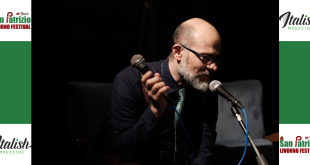
Last June 15th, I had the privilege of attending (with my fellow Beckettian friend B.) one of the most anticipated (for me at least, as it involved “my” Sam…) events of the Dalkey Book Festival, where Barry McGovern, acclaimed as one of the world’s premier interpreters of Samuel Beckett, performed a unique reading from selected works of the 1969 Nobel laureate.
Read the article in Italian on samuelbeckett.it.
Barry McGovern reads Beckett
The venue was filled to its around 200-seat capacity. Young people, older people, families; with my two fellow Beckettians, the aforementioned B. and Federico “samuelbeckett.it” Platania, we often talk about the relevance of Beckett seeming impossible to fade.
We kept on saying that during covid.
And you have wars, refugees, displacement, human beings having to deal with direct provision that doesn’t provide (I was wondering: would Didi and Gogo, two male escapees, have been removed from the tree stump? Would their staying there, indefinitely, be illegal?).
So, in a sad but reassuring way, it’s “normal” to see how close to all of us Beckett is.
I was just thinking, on my way back to my home not far from Cooldrinagh (why, why does it always get personal, when it’s Sam..?) that as long as there will be pain for humans to laugh at, Sam will be successful; and that, should he become irrelevant for a lack of pain for all of us, he would just be happy to, finally, disappear into the nothingness he loved. That ontic, present nothingness (We were just casually discussing the presence of absence in Beckett, as in the West of Ireland, with my neighbour, F., a few hours before the reading) he loved so much. Barry’s performance was not just a reading; it was an embodiment of Beckett’s wit, humour, and profound grasp of the human condition. His selection—a “remix” of passages from Beckett’s novel “Watt” (on which he previously worked in a one-man-show) alongside other works—captured the audience with its dark humour and existential nuances. Notably, McGovern’s portrayal highlighted Beckett’s comedic genius. There were moments, such as the darkly humorous line from “The Expelled”
“They never lynch children, babies, no matter what they do they are whitewashed in advance”
where I found myself, along with others (though perhaps more so for me than for the others…), caught between a chuckle and a shudder at the irony Beckett wields so masterfully.
For me, Beckett’s work is —yes, again— deeply personal. It’s not just in the universal themes he explores but in the minute details that evoke memories of Dublin (Federico: he was, is and always will be an Irishman!). When McGovern mentioned “Johnston, Mooney and O’Brien’s clock,” I was transported back to my own life, not in Leinster Street, where the bakery was in Beckett’s time, but in Finglas. I can play with the idea of the bread still having the same smell Beckett could sniff. It’s less easy to imagine Beckett, the posh southsider, visiting Finglas: a territory definitely closer to another of my favourite Irish writers…
The performance reaffirmed my belief in Beckett’s perennial relevance. His exploration of existential dread combined with mundane intricacies creates a tapestry that feels, again, as pertinent today as ever. The gran finale couldn’t be better than it was:
I must go on, I can’t go on, I’ll go on.
Altogether, McGovern’s ability to draw laughter through Beckett’s contemplation of life’s absurdities showcases his skill.
What Beckett himself might call “risus purus” or pure laughter (in a word the laugh that laughs—silence please—at that which is unhappy) was a testament to the layered richness of the texts and of the performance.
Ending the evening, I couldn’t help but daydream about bringing this performance to Livorno at the San Patrizio Livorno Festival. Imagine Barry McGovern, under the Italian stars, bringing Beckett to life—it’s a thought that excites and inspires.
As the crowd dispersed into the inexistent night (the indetermination of everything is as Irish as Beckettian: it’s ten pm and you have plenty of light; but, then, it’s 3 pm and it’s dark already…), I went back home via Dart. I took off earlier than Blackrock, my favourite stop. And if you get this along with the previous lynching, you are a true Beckettian indeed…